1800 – 1899
[19th Century] A drover from the Dolgellau area could received three shillings (15p) a day, and a six shilling (30p) bonus on reaching his destination.[c.19th Century] People used to ride up Cader and at one time as many as forty to fifty sturdy Welsh ponies were kept at one hotel for this purpose, and another hotel advertised ‘ponies and guides, fixed, moderate prices’. One of the most famous guides was Robert Edwards, who at the age of eighty-four used to hand out printed circulars to visitors, describing himself as ‘being by chance made a glover, by genius a fly dresser and angler, and now, by the all-divine assistance, conductor to and over the most tremendous mountain, Cader Idris’
[1800] Rev J. Evans in A Tour Through Part of North Wales in the year 1798 and at other times, claimed that Dolgellau ‘is improving in building and population from the increasing trade in coarse cloth, it promises to become no inconsiderable place’
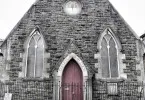
[1800] Judah Baptist Chapel built on Cader Road
[1800] Siop y Seren Built
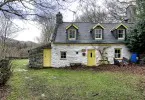
[1800] Tan y Gader Built
[1800] Plas Newydd Bays Added (Overlooking Eldon Square)
[1800] The Town’s Woollen Industry Reached its Peak
[1801] 1801 census records 2,949 residents
[1801] A petition was sent by the parishoners to the Bishop of Bangor, praying that as the Rector lived 2 miles away “the six o’clock service on Sunday be abolished”. Two other service were held on Sundays
[1801] Eldon Square named after the Chancellor of England in1801, Lord Eldon, a friend of the Vaughn’s at Nannau
[1802] Another outbreak of smallpox hits the town, but not as bad as in 1794
[1803] The Town’s First Bank Opens at Y Lawnt
[1803] The Parish bought a hearse, hiring it out at increasing charges each year
[1803] Cader Idris Volunteers established as England declared war on France. The group consisted of six companies and was raised by Sir R. W. Vaughan Bart MP, with its H.Q. at Dolgelley
[1805] John Morris was paid 26 shillings (£1.30) to clean Dolgelley’s streets once a week, for 9 months
[1806] St. Mary’s Opened a New Burial Ground on The Marian
[1808] Richard Fenton wrote ‘The Masonry of Dolgelley merits particular notice. ‘From time immemorial they have been built with very large stones… lifting them with an immense machine which takes above a day to erect, and worked by two men requiring a Lever of vast power’.
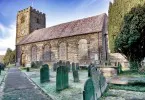
[1809] The Clock and Bell was Added to St. Mary’s Church
[c.1810] Cambrian News 1881 – Shop Fach Tan Drain (Eldon-square) occupied by ‘Shon and Shan Jones – grandparents of local bard Ieuan Ionawr. They raised 21 children who were born in the shop, and all grew up to be strong men and women. There were only two beds and a cot in the house, and all had their alloted five and a half hours sleep every twenty four hours. The shop never closed for nearly twenty years, day and night…. some portion of the family was always astir.
[1811] The Marian Given in Trust to the Town
[1811] New County Jail Built
[1813] Town Jail Demolished (To Make Wat for the Clifton House Hotel)
[1813] The Hollow Tree of the Ghost (Ceubren yr Ellyll) Blown Down in a Terrible Storn at Nannau on 13th July
[May 1813] John Greenwood hanged for carrying quantities of forged notes. Had presented a forged £5 to Catherine Evans for a ‘negus’ (a glass of warm spiced wine) at The Golden Lion
[1813] Cambrian Travelling Guide – ‘The principal Inn is the Golden Lion, or Plas Isa ; The Ship Tavern is a very large newly built inn. At the Angel Inn there is very comfortable accommodation for travellers without a carriage’
[1817] (see 1799 entry) William Jones of Drws-y-Nant, Innkeeper, on the 17th October was empowered ‘to keep a Common Inn, Ale House or Victualling-house, for ONE YEAR from the TWENTYNINTH of this present MONTH of SEPTEMBER, in the House where he now dwelleth at Drws-y-nant aforesaid’
[1817] An order was made to reduce the number of foxes in the area. Ten shillings and sixpence (52.5p) for every fox and five shillings (25p) for every cub
[1817] The Poor Law rates reached a maximum of 17/3 (78p) in the Pound
[1820] An arch was completed near Maes y Brynner on route to The Torrent Walk, which coincided with the death of King George III
[1821] The township of Dolgelley contained 2093 residents
[1822] Poor Law – Dolgelley’s pauper relief was reduced to try to stop the ever increasing roll of pauperism. In general, house rents were paid for people on the pauper list, on which everyone was trying to get. Their cottages were repaired for them, weekly cash allowances and lump sums were handed over, children of paupers were apprenticed with heavy premia, many gifts in kind were distributed. Money was even given to enable people to go to America. (Poor Law details from ‘The Story of Two Parishes Dolgelley and Llanelltyd’ – T.P. Lewis)
[1823] A golden torque was discovered near Llyn Gwernan, belonging to the late part of the Bronze Age
[1824] It was ordered that no one who kept a dog should receive pauper relief
[1825] County Hall (Courthouse) Built (for £3000)
[1825] Church Registers Adopted the Spelling “Dolgellau”
[1825] No pauper owning ‘a clock or any useless furniture in the house’ would receive pauper relief
[1827] Dafydd Ionawr Died (Local Bard and Schoolmaster) born 1750
[1827] The National School was founded
[1828] A drastic revision of Dolgelley’s pauper list ended in its reduction by nearly half
[1829] Sunday School at Salem Chapel Now Contains 400 Children and 71 Teachers
[1830] Eldon Row Built
[1830] The Stagecoach Journey from The Golden Lion Hotel to London Takes 24 Hours
[1831] Bodlondeb prison about 1/4 mile up Cader Road, built. It was to replace the Clifton goal which was built in 1751 & closed 1831. The Clifton housed the last two men to be publicly hanged in Merioneth.
[1833] A writer said that 1,400 people employed in flannel. 30,000 pieces made annually, averaging 110 yards each.
[1835] Leigh’s Guide to Wales and Monmouthshire. ‘The tourist will do well to make this (Dolgellau) his central station while he examines the various beauties of the neighbourhood, as there is perhaps no place in the principality from which excursions may be made with so much advantage’
[1835] J Hemingway – Panorama of the Beauty, Curiosities and Antiquities of North Wales. ‘There are many well built houses in various parts of the town (Dolgellau), including a good range, fronted by shops, called Eldon Row, the property of Sir Robert Vaughan; but in general the houses are erected with such extreme irregularity in regard to each other, as to convey but a mean idea of the projector’s good taste’
[1835] J. Hemingway – ‘Part of the building in which a parliament was held by Owen Glyndwr is still standing among a group of old houses, having a post-office in front, near the Ship Inn, and is called Cwrt Plas yn y Dref, ‘the town hall court’
[1835] The Postmistress was Jane Owen, based at Queen’s Square
[1836] Sir Robert Vaughan, in his account books, adopted the spelling “Dolgellau”
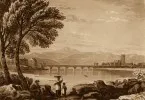
[1836] Thomas Roscoe in Wanderings and Excursions in North Wales. ‘ A pleasant walk of about a mile and a half beyond Llanelltyd brings the traveller to Dolgelley, which is encircled by mountains, and seated on the river Wnion, here a broad, shallow stream, over which is a handsome bridge of seven arches. It has a neat church, containing some old monuments; and a commodious county-hall’
[1836] The last Poor Law rate in Dolgellau was 12/4 (62p) in the Pound
[1837] The Poor Law passed into administration of a Board of Guardians.The assessments undertaken by the Board were increased dramatically
[1839] Judah Chapel was Rebuilt
[1839] Sir Robert Vaughan rebuilt The Golden Lion. The King of Sardinia, Grand Duke Constantine of Russia and Prince Louis Lucian Bonaparte have stayed there
[1839] The Dolgelley Board of Guardians decreed that apprenticing to trades be abandoned, if employment could be obtained anywhere as a farm labourer
[1842] Parliament was petitioned by Dolgellau locals to return to the old system of Poor Laws, but the petition failed. Corruption was rampant with the overseers allegedly embezzling much of the proceeds
[1842] Some of the estimates for the parish church expenses included; winding the clock £2.2 shillings (£2.10p) and new bell ropes £8.00
[1843] Sir Robert Vaughan (Local County MP) Died
[1845] The Board School was founded
[1846] August 25th – To be sold at auction… by Mr William Ellis at The Golden Lion… That Capital and Genteel residence, called BRYNHYFRYD. The house consists of an excellent Dining Room, Breakfast Rooms, Man’s Pantry, Housemaid’s Closet, excellent cellars, one of which contains good Spring Water, and many other conveniences…. The house has been chosen and occupied by her Majesty’s Judges while on circuit. For further particulars apply to Messers. OWEN and GRIFFITHS, Solicitors, Dolgelley.
[1846] Edward Parry – Cambrian Mirror or a New Tourist Companion through North Wales. A traveller sitting over his wine was asked to describe Dolgelley, when taking a handfull of nutshells, and placing the cork on its end, he threw the shells carelessly around it, saying the same time, ‘there is the plan of Dolgelley: the cork represents the church and the shells the small Houses’
[1847] Mormon preacher Edward Roberts visited the Dolgellau and Llanelltyd areas
[1850] The Town Now Had 11 Mills
[1850] An Old Rhyme of Dolgelley (by Thackeray). When you go to the town of Dolgelly, don’t stay at the Lion Hotel, There’s nothing to put in your belly, and no one to answer the bell.
[1851] Shop Fach Eldon-square was pulled down (see c 1810 entry). Owned by Sir Robert Vaughan, it was occupied for several years by David Jones, bookbinder, a zealous and active temperance advocate
[1855] The Grammar School Headmaster eaned between £35 to £40 per annum
[1855] A committee selected to arrange for lighting and watching the town at a cost of £80 per year
[1855] Ship Hotel, with some land, was rented at £20.13 shillings (£20.65p) and The Golden Lion at £19.15 shillings (£19.75p) per year
[1862] £70,000 worth of gold sold by Clogau Gold Mine to England
[1862] The last Brigantine (Ship) was built in Penmaenpool and was the “Charlotte”, Capt. Black in charge. Boats were launched broadside in Penmaenpool. Locals were employed to help launch by rocking the boat. Vast quantities of free beer were taken prior to assist in this dangerous job
[1864] St. Mary’s Chancel Added
[1864] A Mr Smith, a keen walker, left Machynlleth in September to climb Cader Idris. He refused to pay a guide the 15 shillings (75p) fee to take him up and down the mountain. Night was approaching and bad weather forecasted. Against the guides’ advice, Mr Smith went on alone. Six weeks passed and nothing more was ever heard of Smith. His brother came to make enquiries, but to no avail. The following May, a man’s dog started barking whilst on Cader, and its owner, looking over a precipice, saw a dead body – a skeleton in clothes, having been ravaged by foxes and ravens. A knapsack found nearby confirmed the body’s identity as that of Smith. He had fallen some 1300 feet
[1864] As a market town, Dolgellau paid £255 18s 6d Excise Duties for the year ended 24th June
[1865] As a market town, Dolgellau paid £256 19s 3d Excise Duties for the year ended 24th June
[1866] As a market town, Dolgellau paid £279 5s 1d Excise Duties for the year ended 24th June
[1867] As a market town, Dolgellau paid £307 9s 1d Excise Duties for the year ended 24th June.
[1868] Tabernacl Chapel Built
[1868] The Railway Arrives
[1868] Y Dydd (The Day) Newspaper First Published
[1868] The navvies working on the extension of the railway line from Bala to Dolgellau used to pour into The Old Tavern (Drws-y-nant, see entry 1817) for drinks. Attached to the the inn was a lean-to, since demolished, called Cegin-y-Gwyddelod, (The Irishmen’s kitchen). This was set aside for the Irish navvies, for the Welsh refused to drink with them
[1868] The “Hen and Chickens” hotel was demolished because of the arrival of the railway. The hotel stood on the site of the old Toll House on the north side of Y Bont Fawr (also later demolished)
[1869] Charles Darwin wrote to Sir J.D. Hooker “We have a beautiful house, with a terraced garden, and a really magnificent view of Cader right opposite. Old Cader is a grand fellow, and shows himself off perfectly with every changing light”. He was living at Caerdeon near Bontddu and writing his Descent of Man at the time
[1869] Dolgellau Court. Mary Thomas was found guilty of leaving her pigs to stray in Lombard Street on the 1st May. John Thomas a postman was found guilty of allowing his donkey to stray on the 5 May on the turnpike road from Dolgelley to Towyn. Both were fined 2/6 with costs, or if in default, 7 days imprisonment. They were charged with the offences by Police Constable Evans
[1870] Neuadd Idris Built
[19th Century] The Welsh Gold Rush
[c. 1870] Robert Meredith founded a light leather tannery, dealing with sheepskins (see 18th Century entry).
[1870] (March 15th) Miss Mary Owen, landlady of the Golden Goat Inn, was found not guilty of causing drunkenness at her Inn, when it could not be proved that she had knowingly supplied the accused with drink
[1870] Meredith Richards presented 19 handsome and interesting volumes for the use of inmates of the workhouse. These were in English and a number of Welsh volumes would also be supplied. He had also previously presented flower seeds for the decoration of the pasture in front of the workhouse
[1870] (12th June) Prisoner Edmund Williams alias ‘Ned of Grogwyn’, escaped from Dolgellau County Gaol. He was undertaking 18 months imprisonment for burglary. He scaled a wall and made his escape supposedly to Liverpool. He was aged 28, five to five and a half feet tall and had a speech impediment. A handsome reward was offered for his apprehension
[1871] Rev Francis Kilvert drove by omnibus from Barmouth junction to ‘Miss Roberts’ Hotel, The Golden Lion, Dolgelly’, staying for a few days.(Kilverts Diary) (on 12th June)
[1871] Kilvert’s guide on Cader Idris, a Mr Pugh told him that ‘This is the highest point of Cader Idris’, laying his hand on a peak of wet living rock, ‘not that’, pointing at a great conical pile of stones built upon the peak by sappers and miners during the Ordnance Survey ‘The Captain of the surveying company had his tent pitched on the top of Cader Idris for 3 summer months and never left the place. He had 18 men to wait upon him. And how many clear views do you think he got in that time? Nine’
[1872] Mr. John Meyrick Jones, Meyrick House was given Royal Patronage for his Welsh tweeds by Her Royal Highness, The Princess of Wales
[1872] The Caernarvon and Denbigh Herald – ‘CHRISTMAS DECORATIONS… The shops decorated with the greatest taste were Shop Newydd (Mr Richard Jones); Mr D.E. Hughes, draper; Mr Griffith Jones, grocer; Mr Richard Mills do; Mrs Miles & c. Several butchers displayed a fine show of Christmas meat, and that the window of Mr Edward Jones was of a very superior character’.
[1873] A visitor wrote ‘No visitor should visit Dolgellau without seeing the primitive way flannels and tweeds are made’.
[1875] Tolls into Dolgellau abolished. From a slate on one of the old toll houses on the road from Bala. ‘Every Horse or other Beast drawing any Coach, Chariot, Chair with four wheels 6d (2.5p), For every other Horse or Beast drawing any wagon with four or two wheels 4d (2p), For Every Horse or other Beast laden or unladen and not drawing 1.5d (1p); For every drove of Oxen, Cows or Meat Cattle per score and so in proportion for any less number 10d (4p). For every drove of Calves, Hogs, Sheep, Lambs or Goats per score and so in proportion for any less number 5d (2p)
[1875] The town’s fire engine was almost unserviceable when called upon to deal with a small fire at The Red Lion, the last time it was used. Previously used by ‘the waterman and the local board officers’ to water the streets of the town during very dry weather
[1875] Gerard Manley Hopkins (Jesuit Priest & Poet) reputedly wrote the poem Penmaen Pool about 1875 in the visitors book at the George III Hotel
[1877] Cadwalader Jones of Parc Farm was the Last Person to be Hanged in Dolgellau for the Murder of Sarah Hughes (Took Place on 23rd November
[1877] Eglwys Bethel (M.C.) built. (M.C. is Welsh for Calvinistic Methodists)
[1878] Dr. Williams School for Girls Established
[1879] Penmaenpool Tollbridge Built Across the Mawddach which replaced 24 hour (one man power) ferry service across the river. The ferry service was still going in May 1892. The bridge had to have a large centre span (30 foot) should there be a resurgence of the boat building trade at Maes Y Garnedd, Llanelltyd and a seagoing vessel need to pass through
[1880] Ebenezer Chapel Built
[c.1880] Dolgellau woollen export trade creates shipbuilding industry on the Mawddach. Produce taken by packhorse from Dolgellau to Llanelltyd, then on to Barmouth by Sloop for transportation to Liverpool. Exporting to South Carolina, Africa, Germany Holland. British Army fought in Dolgellau woollen clothes
[1881] Cwrt Plas yn Dre (Old Parliament House) Demolished. Cambrian News November: ‘The Old Parliament house was bought by Mr Thomas Roberts, ironmonger, Bank Buildings, for the purpose of erecting new business premises. One of the greatest attractions in Dolgelley is gone , and no business convenience will ever repay the loss’. It was rebuilt at Milford Road, Newtown, where it is currently a Quaker Friends Meeting House
[1881] May – Cambrian News – the house of Mr Evan James, mason, took fire. The river Arran and mill stream… supplying an abundance of water… the fire was soon put out. Its close proximity to a large block of buildings consisting of Y Dydd Printing Office, The Unicorn and Talbot hotels… (had the fire spread)… a large portion of the town would have been in imminent danger
[1881] January 14th – Cambrian News – ‘TOWN IMPROVEMENT – At last the old houses at the top of Eldon-square, the property of Mr Jones, of Glandwr, are being pulled down…. the thickness of the wall of the gable-end, including the chimney was seven feet’.
[1881] Dr Williams Schools’ Principal Head Teacher was Emily Armstrong, a 35 year old spinster from Middlesex. Ellen Pritchard (29) from Islington and Eliza Cowell (38) of Newcastle were Governesses. Mary Tritton (18) was the only other pupil teacher. The school had 19 boarders, a cook, housemaid, kitchenmaid and laundress
[1881] Richard Willams (37) was the town’s Postmaster. The Post Office was also a draper’s shop. Assistants there were Taliesin F. Williams (19), William Pugh (18) and William Powell (17)
[1881] Dolgelley Union Workhouse had, as its Municipal Workhouse Master, William Williams residing there with his wife Dorothy and sons Griffith and Edward. Evan Williams was the Workhouse Task Master, with Sarah Jones a domestic worker and Anne Evans the Workhouse nurse. It contained 58 pauper inmates, the oldest being 81 year old Lewis Pugh, an Agricultural worker, and 1 month old Hugh Williams, son of Gwen Williams, the youngest. The Workhouse had the following handicaps recorded against some of the paupers; ‘idiots’ 7, ‘imbeciles’ 6, and 1 ‘lunatic’
[1886] T.H. Roberts Built
[1890] The 13th Century Silver Guilt Chalice and Paten from Cymmer Abbey were Found Hidden Under a Stone in Cym-y-mynach
[1891] The Gossiping Guide To Wales was Published
[1893] Salem Chapel Built
[1894] Gill’s Imperial Geography ; WALES; INDUSTRIES: Dolgelley, Welshpool and Newtown make flannels and blankets
[1895] The Provincial Eisteddfod was held at Dolgellau on the 16th and 17th August. These were getting common in Wales since the National Eisteddfod was suspended. Special praise was given to committee secretaries, Rev John Jones of Rhydymain, and Mr Lewis Williams, an auctioneer in Dolgelley