Cymer Abbey & Afon Mawddach Riverside Walk
Park at the car park by Llanelltyd bridge and walk up to the ruins of Cymer Abbey. Just before the Abbey, there is a gate on your left which follows the river tough a couple of gates and a stile. You can follow it to the end and climb over stile and up a steep bank to end up on a quiet road which leads back to Llanelltyd.
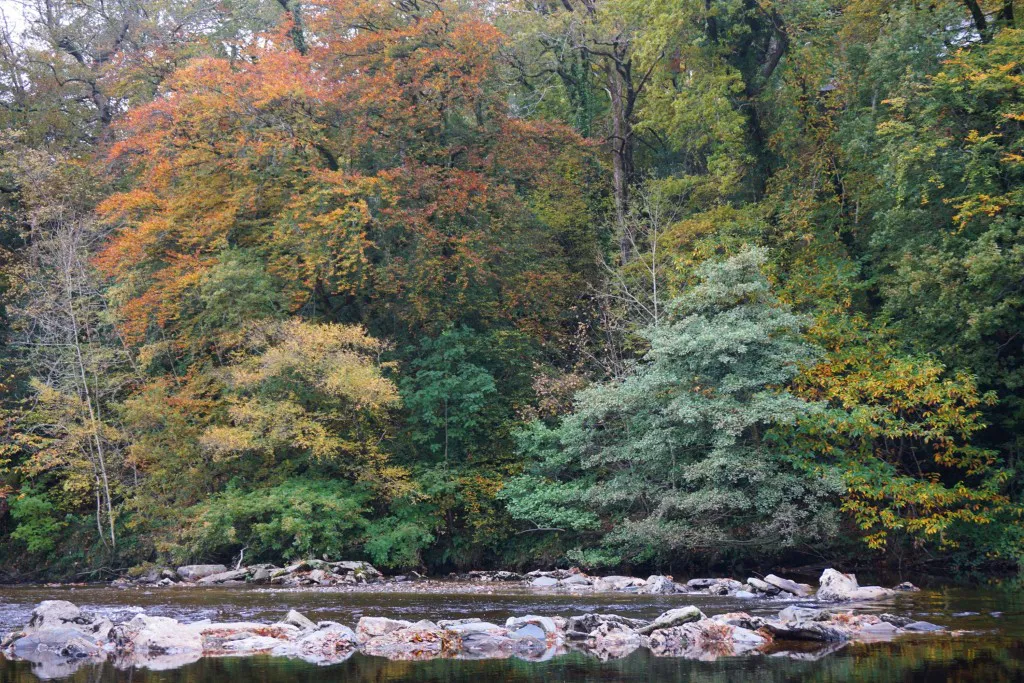
Walk from Cymer Abbey Along The Mawddach in Autumn
Ffynnon
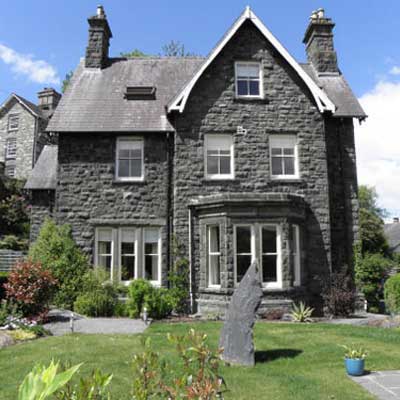
Ffynnon
Situated in the picturesque Snowdonia National Park, Ffynnon Hotel offers 5-star boutique accommodation with magnificent mountain views. The beaches of Cardigan Bay are a 15-minute drive away. Guests can take walks along the forest footpaths that surround the hotel, and climb Cader Idris for spectacular views of the rugged landscape.
Ffynnon combines traditional and contemporary features, including a peaceful library and an outdoor hot tub. The individually designed rooms all have luxury bedding and a flat-screen, satellite TV, and some have freestanding baths. A cooked Welsh breakfast is served in the morning, and a buffet selection is also available. Guests can make use of free wireless internet, and free private parking on site.
Ffynnon is an hour’s drive from Mount Snowdon. The beautiful market and university town of Aberystwyth is also just an hour away by car.
View on the Booking.com Website
Bala Lake Railway
Bala Lake Railway “Rheilffordd Llyn Tegid” offers visitors a beautiful nine-mile return journey beside Bala Lake. The hour-long journey offers stunning views of the lake and Aran mountains (Arenig Fawr, Aran Benllyn and Aran Fawddwy).
The railway currently has four narrow gauge steam locos running; “Alice”, “Holy War”, “Maid Marian” and “Winifred” (all built by the Hunslet Engine Co. of Leeds).
Visit Their Website at bala-lake-railway.co.uk
Map showing all The Great Little Trains of Wales
Dolgellau Chronology 1 (Romans – 1799)
[Roman Times] Signs of Roman “Traffic” at Ffynnon Mair (Mary’s Spring). Roman road passes near Dolgelley, and on the site of the town, coins bearing the inscription “Imp. Caesar Trajan” have been found
[480] Death of Illtyd Farchog (Iltulus), born in Brittany. Gave Llanelltyd its name
[7th Century] Christian missionaries founded a settlement in Dolgellau
[11th Century] Invading Normans under William Rufus, leave the area – ‘returned empty handed having gained nothing’.
[11th or 12th Century] Dolgellau First Inhabited as a “Serf” Village
[1100] Nannau sited at 700ft, it is reputed to be the highest mansion seat in the country. The site was the home of the descendants of Cadwgan, son of Bleddyn, Prince of Powys, since 1100. It was the residence of Howel Sele, a cousin & enemy of Owain Glyndwr
[12th Century] Original St. Mary’s Church Built
[1111] Cadwgan (of Nannau), the founder of Dolgellau Died in Welshpool
[1116] Cymer Castle (Castell Cymer), Llanelltyd a native Welsh castle was built in 1116. The mound or motte was built by Uchdryd ab Edwin. The tree covered motte can still be seen, but contains a stone ‘folly’ on top. The wooden castle is also ‘famous’ for being built and destroyed in the same year (1116).
[1198/9] Cymer Abbey Founded Under the Patronage of Maredudd ap Cynan (Lord of Meirionydd)
[c.1200] Dolgellau first connected to the wool trade.
[1209] Cymer Abbey was Granted a Charter by Llywelyn the Great
[1212] Maredudd ap Cynan (Lord of Meirionydd and Founder of Cymer Abbey) Died
[1240] Llywelyn ab Iorwerth “The Great” Died
[1253] First Document Mentioning St. Mary’s Church “Dolkelew” (in the Norwich Taxatio). This is the Earliest Recorded Spelling of the Town
[1282] Llywelyn ap Gruffudd “The Last” Died
[1284] The Monks of Cymer Abbey Were Awarded £80 Compensation for the Damages Caused by the English Wars
[1285] Another Recorded Spelling of the Town: “Dolgethley”
[1285-1310] Edward 1st makes survey of Merioneth (similar to Domesday Book). Residents of Dolgellau were tenants of the Crown – primarily Welshmen (cattle breeders) and foreigners (Englishmen and Irishmen – agricultural workers).
[1291] St. Mary’s Church Mentioned again in the Taxatio Ecclesiastica
[1291] St. Illtyd Church Built in Llanelltyd
[1295] Edward 1st visited the town and received homage of local tribal chieftains.
[14th Century] St. Mary’s contains a 14th Century effigy of Meurig ap Ynyr Fychan, an ancestor of the Vaughan family of Nannau
[14th Century] Poet Gruffydd ap Adda murdered in the streets of Dolgelley
[c.1340] Walter de Manny established fairs and markets (Vicecombe of the Shire of Merioneth). Tolls were 3.5% of the selling prices of goods
[1349] Owain Glyndwr born
[1388] Cymer Abbey Only Housed Five Monks
[1400] Owain Glyndwr’s Revolt Begins
[1402] Owain Glyndwr Attacked Nannau and Captured Hywel Sele
[1402] Owain Glyndwr Battled Griffith ap Gwyn (Who was Trying to Rescue His Father-in-Law Hywel Sele). Gwyn Lost 60 of His 200 Men on Llanelltyd Bridge
[1402] Hywel Sele Tried to Kill Owain Glyndwr. But Glyndwr Killed Sele and Stuffed His Body Into The Hollow Tree of the Ghost (Ceubren yr Ellyll). When it Lay Hidden for 40 Years
[1404] Owain Glyndwr held the last Welsh Parliament in Dolgellau. It was from here that Owain Glyndwr sent letters to the Kings of Scotland and France, asking for help and pleading the justice of his fight against English usurpation, signing himself ‘Owinus, Dei gratia princeps Walliae datum apud Dolgeuelli 10 mie mensis Maii, MCCCC quatro’
[c.1416] Death of Owain Glyndwr in hiding
[1445] Fresh survey of Merioneth – ‘land now lying derelict for want of men’
[1514] William ap Jenkin ap Iorwerth charged with having terrorised Dolgelley
[1536] Henry VIII Dissolved All Monastaries Earning less than £200 per Annum (Cymer Abbey was Earning £51 and was Dissolved)
[1555] Lewis Owen, vice-chamberlain of North Wales, and baron of the exchequer of North Wales cruelly murdered by The Red Bandits of Dinas Mawddwy. The Red Bandits were known as “Y Gwylliad Cochion” as they had red hair
[1576] Dolgellau was leased out by the Crown and surveyed in the Rolls
[17th Century] Plas Newydd Built at the top (Did Not Have the Bays Originally)
[1606] Y Sosban (The Old Town Hall) Built
[1638] Y Bont Fawr (The Big Bridge) Built. Originally it contained 10 arches but 3 were lost when the railway was built
[1640] St. Mary’s Started to Keep Regular Church Registers
[1650] George III Built in Penmaenpool
[1651] St. Mary’s font has the date 1651. West windows contain 18th Century stained glass
[1657] George Fox Leader of the Quakers Visited the Town and The Quakers were Established in Dolgellau
[1662] A Print of the Old St. Mary’s Church Published (with the church-bell is suspended in a yew-tree)
[1662] Thomas Fuller wrote of Dolgellau in The History of the Worthies of England – ‘There are more alehouses than houses. Tenements are divided into two or more tippling houses and chimneyless barns used to that purpose’
[1665] One of the Earliest Grammar Schools in Wales was Built
[1666] Robert Vaughan of Hengwrt Died
[1675] George Fox visited the area saying he had found an earthly Paradise and that ‘here is a valley of peace and beauty’.
[1678] Register of Dolgellau Parish Church (1678 – 1708). Entries of burials confirmed that woollen shrouds were being used. A law was passed in 1678 to encourage the wool trade, making it obligatory to use these shrouds
[1686] Rowland Elis, a prominent local Quaker, emigrated to Pennsylvania
[1694] Robert Norden’s map of North Wales links the mail route from the West Midlands with Caernarfon via Dolgellau for the first time, among a few other Welsh towns. In those days, the Inns doubled up as post offices, to serve the travellers
[1700] Wtra Plas Coch Built
[18th Century] The town had 6 Skinners Yards, 3 Tanneries. About 100,000 local lambskins, as well as many kid skins were sent to Worcester and Chester every year and some to London. There were two kinds of tanneries ; heavy leather that tanned hides, and light leather dealing with sheepskins
[1715] Death of Dr. Daniel Williams. A trust was established from his will to eventally set up Dr. Williams School
[1716] Old St. Mary’s Church Demolished
[1716] Town Jail Built (The Clifton House Hotel now stands on the site).
[1721] Reverend Ellis Lewis left a sum of money for a peal of eight bells at the Parish Church. 1st, 2nd and 3rd chimed for Divine Service, 4th for curfew, 5th for a fire, 6th for a funeral, 7th (Y gloch goll) for someone missing on Cader Idris, and the 8th was for Communion
[1725] Baron Richards born at Coed, Brithdir in Dolgelley Parish. Well educated, he became Chief Justice of Chester, Baron of the Exchequer and Lord Chief Baron
[1750] John Wesley visited Dolgelley, making non-conformity a force
[c.1755] The road to Bala was built, replacing the old track
[1765] Richard Wilson painted “Cader Idris – Llyn-y-cau”. Now hanging in the Tate Gallery in London. One of the masterpieces of 18th century art
[c.1770] Bakery established in The Lawnt – Popty’r Lawnt
[1780] Fulling Mills Extablished
[1791] Universal British Directory. Dolgelly – Situated at the bottom of that romantic high hill called Kader Iris. Here is a modern-built parish church. The buildings in general, are low and irregular. The markets are on Tuesdays and Saturdays, and there are 7 fairs in the year. The tide flows within a mile of the town. The principal occupations of the town are, Physicians 2, Lawyers 3, Merchants 7, Grocers 4, Web-manufacturers 11, Web-merchants 1 Tanners 3, Skinners 5, Mercer 1 Currier 1, Carrier 1, Corn factorer 1, Timber merchant 1, Woolstapler 1, Plumber/glazier 2 and Sadler 2
[1794] Thirty six people die of smallpox in Dolgelley
[1796-98] Intollerable Poor Law pressed on Dolgelley.The 1796 poor rate was 8 shillings (40p) in the pound
[1798] The Earliest Printing Press Opens
[1798] Fifteen shillings (75p) paid to a Mary Jones for washing Parish linen
[1798] The Baptists were established in the town
[1799] Hen Dafarn Drws-y-nant (The Old Tavern at the Gateway of the Stream) was rebuilt by Sir Robert Hywel Vaughan. It stands up the steep pass of Garneddwen, between Dolgellau and Bala, a wild and unhinabited region. Was once described by a traveller as ‘a poor hovel’
Foel Offrwm
This walk starts at the Precipice Walk car park and can be done at the same time as it’s only 30-40 minutes to the top (0.8 miles). While the Precipice Walk car park can be full in peak times, only a few of those people will be walking this route. I have done it a few times and never seen another soul on the way up, or on the way down. There are no markers at any point along the route, which may account for this.
Starting at the car park at 750 feet, the first half is a gentle climb (only ascending around 100 feet), while the second half is a steeper affair over rough stony and uneven ground and 400 feet of ascent.
Starting from the car park, cross the road you just drove up (if you drove up from Dolgellau) and take the signed path opposite. Before you get to the gate, turn right up a sloping path and over the fence (this path is NOT signposted) and follow the feint grassy path around the base of the hill until you reach a wall. It’s all pretty easy from here, just turn right and follow the wall up (and I mean UP!). This path is uneven and steep, but keep stopping and look back for some nice views of Coed y Brenin, Northern Snowdonia and the village of Llanfachreth and its church dedicated to Celtic saint Machreth.
Once at the top you are rewarded by a walk around the ruins of an Iron Age Hill Fort and a stone tower (of later construction). You also get some stunning panoramic views, including Dolgellau, Barmouth and a nice view of Nannau house and gardens below.
The route down is a little trickier with the uneven ground, but you are helped by the fact that there is a stone wall to hang on to.
Coed-y-Brenin
World famous Mountain Biking centre near Dolgellau. Forestry Commission Wales’ mountain bike Mecca Coed-y-Brenin forest is home to an ever increasing network of fantastic all weather tracks, which include ‘Falseteeth’ incorporating the biggest feature in the forest, ‘The Cavity’.
Dolgellau Chronology 3 (1900s)
[1901] Police Sergeant Richard Owen, of Trefeglwys lived at Dolgelley Police Station, with his wife Martha and son Idris Wyn Owen
[1903] Bont Fawr Damaged by Floods
[1903] Robert Roberts and his newly married wife, moved to live at The Old Tavern (see 1868) and farm but were teetotallers. General Vaughan of Nannau (owner) agreed to take away the licence. The Inn was renamed the Hywel Dda, and mineral waters and tea replaced the beer for which the Inn was famous for years. The inventory drawn up when Robert Roberts took over was as follows: Crops, cattle, farm implements, harness etc. = £143, 7s, 6d. 400 sheep at 22s, 9d per head = £455, 0s, 0d. Barn, fences, etc. = £45, 0s, 0d. Contents of house: = £26, 13s, 0d. Total = £670, 0s, 6d
[1903] September – Football – Dolgelley South Side drew 0-0 with Dolgelley North Side in a game played on The Marian
[1903] September – Football – Dolgelley County School lost at home to Bala County School in a game played on the Cattle Showfield. The Dolgelley team was; G. Ellis, R.J. Davies, J.P. Jones, J.C. Owen, J. Jones, O.L. Evans, T. Hughes, R.R. Jones, R.E. Evans, T. Jones, J.M. Roberts.
[1904] Buffalo Bill’s Wild West Show comes to Dolgellau on 6th May 1904. It is held on The Marian.
[November 1910] A communication from Mr A. Carnegie stated he was willing to give £1,000 towards the proposed new Free Library, having approved the plans. A suitable site has already been procured and paid for by public subscription
[1911] 1911 census gives Dolgelley’s population as 2,160
[1912] H.V. Norton ‘In Search of Wales’, visited ‘Dolgelly’ stating he ‘might be in the Austrian Tyrols as the square is crowded with mountaineers’
[1913] Dolgelley Free Library and Institute opened by J. Myles Esq MD in May. The library is on the site of the Blue Lion Inn
[1914] (May) Dolgelley Cricket Club. At the AGM chaired by Arthur Roberts, the audited funds balance stood at £3 17s 6d (£3.78) and was recorded as a good start to the season. Other club officers for 1914 were Captain; Mr D. R. Meredith, Vice Captain; Arthur Roberts, Treasurer; Mr R.R. Jones, Hon Secretary; Einion Evans, Groundsman; Richard Ellis. A complete fixture list is in the course of preparation
[1918] 107 Men from Dolgellau and Llanelltyd Died in the Great War (from a Total Population of Just 2500 Men, Women and Children)
[1920’s] The Prince of Wales (the future King Edward) visited Dolgellau and the Dr. Williams School
[1920] The tenants of the Golden Lion (1920-1925) were Quellyn Roberts & Co., Wine Merchants of Chester (still there in Westgate Street). The Robert’s paid Major General John Vaughan, CB., CMG., DSO., an annual rent of £150 (25/03/1920)
[1920] Mr. E.E. Jones Dolgelley took the title in the Champion Challenge Cup Competition for the Championship of Merionethshire, beating Mr T.J. Roberts
[1920] 1920 Rail distances from Dolgelley Station; Aberdovey 22.5 miles, Aberystwyth 44 miles, Bala 18 miles Barmouth 10miles, London 243 miles, Machynlleth 31.5 miles
[1921] (June) The County Council asked the Urban Council to enter into a fresh contract for the repair of main roads for the year ending March 31st, 1922, at £280. The Urban Council declained and pressed for £400.
[1921] Fire Brigade Competitions. Dolgelley won the Hydrant drill for the ‘Byrne’ Challenge shield in a time of 14 4.5seconds. They also won the Ambulance Competition Challenge Cup in First Aid in the fire service with 16 points
[1921] Quoits. 58 competitors played for the Merioneth Silver Challenge Cup at Bala. The winner was veteran Mr. Johnson of Dolgelley, beating Mr. Evan Williams also of Dolgelley
[1922] The Town Flooded
[1922] Dame Margaret Lloyd George entertained the Old Girls of Dr. Williams School at Number 10 Downing Street, because she was an Old Girl herself as was her daughter, Lady Olwen Carey Evans
[1922] Dolgellau FC were runners up to Barmouth in the Welsh National League, Coast Section, winning 6 and losing 2 of their 8 games. Barmouth 13pts, Dolgellau 12pts, Pwllheli 5pts, Harlech 4pts and Towyn Rovers 4pts
[1923] The Angel Hotel in Eldon Square Demolished
[1923] Dolgelley has a Social Club in Lombard Street, near the Square, with baths, an excellent library, a reading room and billiard tables. Visitors 2s 6d a week or 5s a month (From a tourist handbook “North Wales Complete Edition”, published by Ward Lock & Co – circa 1925)
[1923] 1923 Dolgelley has a good cricket club, with a well-laid cricket ground and pavilion, visitors are welcomed. The tennis club has courts near the Green and issues weekly and fortnightly tickets to visitors
[1924] Mr. Dafydd Ellis Rowlands started as conductor of a mixed choir at the Tabernacle Chapel
[1924] Dolgelley can be accessed by Great Western Railway via Ruabon and the beautiful valley of the Dee or by Cambrian Railways Coast Line via Barmouth (From a tourist handbook “North Wales Complete Edition”, published by Ward Lock & Co – circa 1925)
[1924] 1924 Fishing fees in the area for the Mawddach and Wnion rivers. 1.5 miles of Wnion preserved by local association. For all kinds of fish 1s 6d a week; 2s 6d a month; 5s a season. Licences, trout and char, 1s the season; salmon 1s a day; week 5s; month 10s; season 20s (£1)
[1924] 1924 Fairbourne fishing tickets, 1s a day at Ynysfaig Hall Hotel for fishing in Llyn Cyri. Penmaenpool fishing for trout and salmon in the Mawddach – 2s 6d a day; 10s 6d a month
[1925] The Golden Lion Royal Hotel was taken over by George & Nesta Olwen Hall in 1925 from the Nannau Estate.
[1925] The town is well lighted and drained, and has an excellent water supply. The town was formerly celebrated for the manufacture of flannel and tweed, but there is now only one small mill. As Dolgelley is the resort of anglers and others during the greater part of the year, and lodging house keepers are not dependent on a short season for their livelihood, apartments may be had on moderate terms (From a tourist handbook “North Wales Complete Edition”, published by Ward Lock & Co – circa 1925)
[1925] 1925 Handbook – On the road leading to the Torrent walk is the County Intermediate School, and on the Barmouth Road is Dr Williams’s Endowed School for Girls, one of the most flourishing and successful institutions in Wales
[1926] Golf – Bala defeat Dolgelley by 6 holes to 5 in the Welshpool Challenge Bowl Competition. The winning Dolgelley golfers were H.T. Wilmott, W.R Brunton, W. Lewis, Richard Jones and R. Ellis Jones. The unsuccessful golfers were D.C. Brunton, J. Jones Williams, H.J. Owen, W. Williams, H. Morris and Llew Owen
[1927] (April) Dolgelley Union Workhouse contained an average of 30 lunatics. Total weekly cost per head was ten shilling and tenpence farthing.. The average number of casuals relieved per night was 5
[1928] Dolgellay & Llanelltyd “The Tale of Two Parishes” Published
[1929] The First Catholic Church opened in Dolgelley since the Reformation
[1929] Eight Carmelite nuns arrived from Notting Hill, London to found a new Carmel in the town, on Cader Road – The Order of the Brothers and Sisters of the Blessed Virgin Mary
[1930] Cymer Abbey Placed in State Care
[1930] 1930 November. Dolgellau FC beat Aberdovery 6-5 in the Cambrian Coast Amateur League. Weather was a strong factor in the result with driving rain and slippery conditions.The return fixture two weeks later saw Dolgellau beaten 10-2, with conditions again wet and slippery. Sandwiched between these games was a 2-1 defeat at Machynlleth. Dolgellau’s team then was (5-3-2); T. Parry; E Evans, H.P. Harris; R.W Parry, Archie Jones, E. Brown; H.P. Evans, I Jones, R.L. Roberts, R.G. Lewis, Joe Roberts
[1933] Dolgellau Tabernacle Chapel became an all male choir, raising over £7,000 for various charities during the Second World War.
[1936] Dolgelley Urban Rent increased to a rate of 6/9 (37p) in the £1 for the half year ended September, an increase of 9d
[1936] Tarspraying of 5 miles of road decreased the nuisance of dust and gave work to the unemployed
[1937] The Plaza Cinema built (Now the Police Station)
[1938] Dame Margaret Lloyd George opened the footbridge over the Barmouth road in 1938, the same year as her Golden wedding Anniversary. It was constructed by Jack Jones’s father (of the ironmongers). It was started 1936 and finished 1937
[1939] The Meredith firm closed the tanning side of their business (see c1860) but continued first as wool merchants and then as fellmongers.
[1939] George & Nesta Olwen Hall installed electric light in The Golden Lion Royal Hotel
[1939-1944] During the Second World War, the Admiralty retained 12,000 acres of land on Cader Idris for training purposes. This included the summit of Cader and districts overlooking the Mawddach Estuary on the North, and Talyllyn Lake on the South
[1939] Dolgelley Albion Football Club lost 3 v 0 to Machynlleth in the first ever final of the Gresham Cup, held at Dyffryn on Sea
[June 1939] The first baby girl was born at the Dolgelley Maternity Home. Her parents were Mr and Mrs H. Evans, Wesley Court
[1940] Among the many gifts received by the Dolgelley Maternity Home on their Pound Day were; 22 lbs of rice, packet of Vim, 2 dusters, 2 toilet rolls and 8 lbs marmalade. The proceeds of the jumble sale amounted to £3 5s 6d.
[1940] (August) Merioneth Spitfire Committee met at Dolgellau and announced that the funds raised to buy a Spitfire aeroplane stood at £4,607. District totals included Dolgellau Urban £247, Dolgellau Rural £1,235
[1946] (July) After 21 years as Headmaster at Dolgelley Grammar School, Mr John Lloyd MA retired. He succeeded the late Mr John Griffiths. During his time there, the school buildings were enlarged, providing more classroom accommodation. Mr and Mrs Lloyd were responsible for the boarding arrangements at the school
[1946] (November) Councillor Rhys D. Jones, Hafan, Dolgelley was appointed Secretary of the Merioneth Agricultural Society and recently retired from the post of Stationmaster at Dolgelley after 46 years service with the Cambrian and Great Western Railways. He was chairman of Dolgelley U.D.C. in 1942. The Society decided to resume holding their Agricultural Show which was suspended during the War
[1947] County Times 18th January. Mr Justice Sellers arrived at Dolgelley by train on Monday evening for the opening of Merioneth Assizes on Tuesday. His Lordship was greeted with the customary peel on the bells of St Mary’s Parish Church and he proceeded to the Judges Lodgings at Brynderw
[1948] The Gorsedd Circle of Stones were Built on the Marian to Herald the National Eisteddfod for Wales
[1948] A crowd of 10,000 on Marian Mawr, witnessed the proclamation of The National Eisteddfod in Dolgelley by Cynan, the Gorsedd Recorder
[1948] Thomas Matson Roberts of Dolgelley, was awarded a silver medal from the Royal Humane Society, a silver medal and bar from the R.S.P.C.A. and King’s commendation for rescuing a stranded sheepdog on Cader Idris. Mr Roberts was accompanied by Mr T. Brooks in the rescue (see 1949 entry)
[1949] Queen Elizabeth II Visited the Town
[1949] National Eisteddfod for Wales held in Dolgellau
[1949] Thomas Matson Roberts, 39, was awarded the Stanhope Gold Medal from the Royal Humane Society for the bravest deed of the year. Mr Roberts was an Ironmonger at Penmaen, Dolgelley and was awarded the medal for rescuing a soldier, Frank Campion, (stationed at Hazebrook Barracks, Allenfield near Reading) from Cader Idris. He was stranded on an inaccissible ledge, 700feet up at Craig Cae, Pen Cae. The acoustics on the mountain were so bad, he could not be found by following his cries for help. The directions for rescue were given by shouting across the valley. Also helping in the resue were Mr T. Brooks and Mr J. Fitzgerald. Mr Roberts was a part time Company Officer of the NFS (see 1948 entry)
[October 6th, 1949] Princess Elizabeth inspected the Boys Cadets of the Royal Welch Fusiliers, who formed part of the Guard of Honour on the Square at Dolgelley, on the occassion of the visit of Princess Elizabeth and Duke of Edinburgh, Earl of Merioneth, to Merioneth. The Princess also inspected the young members of the Merioneth Girl Guides
[1951] Dolgelley Cricket Club. Messers Morrison and Robinson of Dolgelley, presented the club with 2 silver cups to be awarded to the best batsman and best bowler during the 1951 season
[1951] (June) Dolgelley Cricket team consisting of D.M. James, R. Pugh, J.M.C. Meredith, R.Jones, M. Griffiths, Iorwerth Davies, R.W. Parry, EG Davies, A.W. Hill, A.E.H. Leeds, and R.W. Evans beat Towyn
[1953] Council Offices at Penarlag Opened
[1954] Post Office in Meyrick Street Built
[1956] Photographs Taken of the Dolgellau Spring Fair (See “Historic Dolgellau” Page)
[1960 ] The then ‘New’ Post Office at Meurig Street, was Officially Opened in November. William Owen Davies was the Post Master until 1970
[1960] Urdd Eisteddfod held in Dolgellau
[1960s] Hengwrt, burnt down. It belonged to the Vaughan family. Robert Vaughan collected the priceless “Hengwrt manuscripts” now in National Library of Wales, Aberystwyth
[1962] Ysgol Y Gader Opened.
[1962] (February) Police Superintendent John St. David Jones reported at the Dolgelley Licensing Sessions, that 5 convictions for drunkenness had occurred during the year, an increase of 3 on the previous year. No convictions for being drunk in charge of a motor vehicle when being incapable to drive. The previous year had 2 convictions. The Police were congratulated by Alderman E. J. Evans Chairman, as were the licensees and members of the public on a satisfactory report.
[c.1963] Wilfred Pickles presented the popular radio programme ‘Workers Playtime’ from Dolgellau
[1964] The Railway Closed (after several days of heavy rainfall) on 12th December 1964. Train services were suspended between Bontnewydd and Morfa Mawddach because of floods at Dolgellau. Due to their impending closure, they did not re-open to passenger traffic again
[1965] (County Times April 24th, 1965) – A new youth club has been formed in Dolgellau, called the ‘Top of The Pops Club’ which meets at the Band Hall. It’s aim is to keep teenagers off the streets to enjoy games, pop music, refreshments and entertainments. Chairman Dilwyn Parry, Secretary Kathleen Judkins. Club rules included putting litter in the bin and no shouting or screaming allowed.
[1965] (County Times 15th May 1965) – Glamorgan County Cricket Club will visit Dolgellau to play the local club on the 4th September. It will be captained by Bernard Hedges and all available players from the First XI will be there together, with it is hoped, two or three stars from other sports and clubs.
[1965] (County Times 11th September 1965) – RAIN MARS GLAMORGAN VISIT – The match itself was delayed due to rain. Peter Walker damaged three bats on his way to scoring 80 of Glamorgans’s 137 for 5 declared. The Dolgellau Select XI scored 12 without loss before rain curtailed play. (Autographs of the Glamorgan XI from the day can be found on the ‘Dolgellau Archive’ Collectables page)
[1966] Roman Catholic Church built – dedicated to Our Lady of Sorrows. Father Scalpell, the Priest in Charge, wrote more than 25,000 letters to people all over the world to raise money to build the new church, but very much to no avail. Sunday collections varied between only 5 shillings (25p) and 8 shillings (40p). After one mass, hearing his appeal for funds, a stranger remained behind and asked the Father how much he needed to build the church – a five figure sum was quoted. Not long after, Father Scalpell received a letter from a solicitor saying his client would pay the sum requested on two conditions. His client would always remain anonymous and the church must be a fine building, harmonising with its austere, mountainous surroundings. Work started in 1963, and was finished at a cost of £44,000. Stone was selected from four different quarries in Merionethshire and Caernarfonshire to add a variety of stone colour. There is a stone from Bethlehem and a stone from Jerusalem in the alter
[1966] The “Prince of Wales” ferry boat from Barmouth capsized after hitting the Penmaenpool bridge on 22 July 1966. Fifteen people drowned. The late John Hall rowed out his clinker built dinghy “Daisy May” against the tide and saved approximately twenty lives. His chef, the late David Osmond Jones, and barman Robert Huw Jones assisted (Both of Dolgellau). No recognition of bravery was ever made to those involved. The fare paid was 5/= a head return from Barmouth.
[1968] Popular Welsh comedians Ryan and Ronnie played the Neuadd Idris in Dolgellau on October 5th 1968 – Autographs from the day can be found on the ‘Dolgellau Archive’ Collectables page
[1969] The Plaza Cinema Closed
[1969] One of the Earliest Grammar Schools in Wales was Demolished
[1969] ‘Y Stafell Ddirgel’ by local author Marion Eames, was first published, based on the history of the Quaker Rowland Ellis and his household
[1969] December 31st – Eglwys Bethel closed. It’s last minister was Mr Tom Phillips
[1972] ‘Y Rhandir Mwyn’ a historical novel by Marion Eames published, following the history of Rowland Ellis in Pennsylvania
[1975] Dr. Williams School for Girls Closed
[1981] The By-Pass Opened (Taking thr route of the old railway line)
[1991] Quaker Centre Established in Ty Meirion
FAMOUS PEOPLE ASSOCIATED WITH THE TOWN:
• The Pop Singer Duffy attended Coleg Meirion-Dwyfor in Dolgellau and was elected president of the Students Union.
• Dr. John Thomas, 18th Century Bishop of St. Asaph, Lincoln & Salisbury was a native of Dolgellau.
• Gryffydd Owen, the first physician of the newly formed state of Pennsylvania in the 17th Century originated from Dolgellau.
• Robert Owen the Quaker lived at Dolserau Hall.
• The Archbishop of Canterbury, Frederick Temple, founded the Dolgellau cricket team-one of the oldest in Wales
• Beryl Williams – Her parents ran the dry cleaners on the corner of Plas Y Dre. She was educated at Dr Williams and later taught there before making acting her full time work. See the BBC Website for more details. She died at Ysbyty Dolgellau aged 67 in 2004.
Thanks to Ken Davies (www.penmon.org) and Gail Hall for all their help with this page.
This was brought to my attention by john Atkinson and info supplied courtesy of Wikipedia:
Marion Eames (5 February 1921 – 3 April 2007) was a Welsh novelist.
Marion was born in Birkenhead, Cheshire, of Welsh parents, but was brought up at Dolgellau from the age of 4, where she attended Dr Williams’s School. A talented musician (she played the harp and piano), she graduated from Guildhall College, London. Marion worked as a librarian in Dolgellau then at Aberystwyth University before becoming a radio producer with the BBC in Cardiff. She was an early scriptwriter for the long running Welsh soap Pobol Y Cwm and was also for a time a regional organizer for Plaid Cymru.
Her best-known work is Y Stafell Ddirgel (also translated in to English as (The Secret Room), published in 1969. This was later made into a BBC television drama series.
A follow on novel was Rhiandir Mwyn (“The Fair Wilderness”). Her autobiography was published in 1995.
This also from john Atkinson:
Joe “LLwyn” Jones also became an actor in the early days of welsh television at roughly the same time as Beryl Williams. The LLwyn was a farm near the mart which was sold and converted into a residential home in the 1970s.
Dates on this page are taken from various books and other sources, including ‘The Story of Two Parishes: Dolgelley and Llanelltyd’ by T.P. Lewis which is available to read (in full) at dolgellau.me.uk This site also includes other history of the town. Dates cannot be 100% accurate as sources vary.
If anyone can add any more, please contact me.
Llanelltyd
Llanelltyd is a pretty village a couple of miles north of Dolgellau with a beautiful bridge over the Mawddach, the historic Cymer Abbey and a lovely riverside walk.
Cwm Prysor
This walk is further afield than the others in this section as it involves a thirty-minute drive. It follows part of the old railway line that ran from Bala to Trawsfynydd, which closed in 1960/61.
The best place to start is a large layby to the east-end of the walk. You can walk from the parking area right through to Trawsfynydd, but I’ve done it here as a straight 3.9 mile linear walk (and 3.9 back, so 7.8 miles in total).
There is lots to see, but the highlight of the route is the 105 feet high, nine-arched Viaduct which was built in 1882. This is only 0.6 miles from the parking area, so if you just want to visit that, it’s worth it. The walk offers great views across the valley to the Arenigs and Rhinogs as well as passing under a lovely stone bridge and over another (which is where I chose to finish and head back). There are remnants of the railway including a red brick building, pretty impressive cuttings into the rock faces, plus a few pieces of iron work here and there. There were also a few old stone broken tiles along the way (Dennis – Made in Ruabon).
I saw quite a few butterflies and also a pair of Peregrine Falcons nesting high in the rocks. You also look across to the remains of Castell Prysor.
Most of the walk is very easy, but there are a few slightly boggy parts (and it hadn’t rained for a week before I did it), so it might be best avoided after heavy rain. The route starts at 1280 feet and only drops to 915, so it’s pretty flat.
There aren’t great views of the viaduct from this walk, unless you climb over a barbed wire fence either side and walk down a little. Plenty of people seemed to have had this idea before me and the fence was pretty bent, but I’m not not sure I should encourage this.
The line closed when part of the valley was flooded (including some of the track) and became a water supply for Liverpool (Llyn Celyn). The railway was once the only way to get between the two towns before the A4212 road was built in 1964 (as part of the deal with Liverpool).
Portmeirion
Portmeirion is one of Wales’ premier visitor attractions, welcoming 250,000 visitors every year. With free parking, complimentary guided tours and audio visual show, six cafes and restaurants, half a dozen shops, gardens and beaches it is the perfect day out for all the family. Surrounding the village are 70 acres of exotic woodlands with easy to follow woodland trails and coastal walks.
Portmeirion is open every day of the year from 9.30am to 7.30pm.
2016 is also the fourth year of their popular “Festival No.6”. This will be held on September 1st-4th, 2016.
Read more about Portmeirion at portmeirion-village.com.
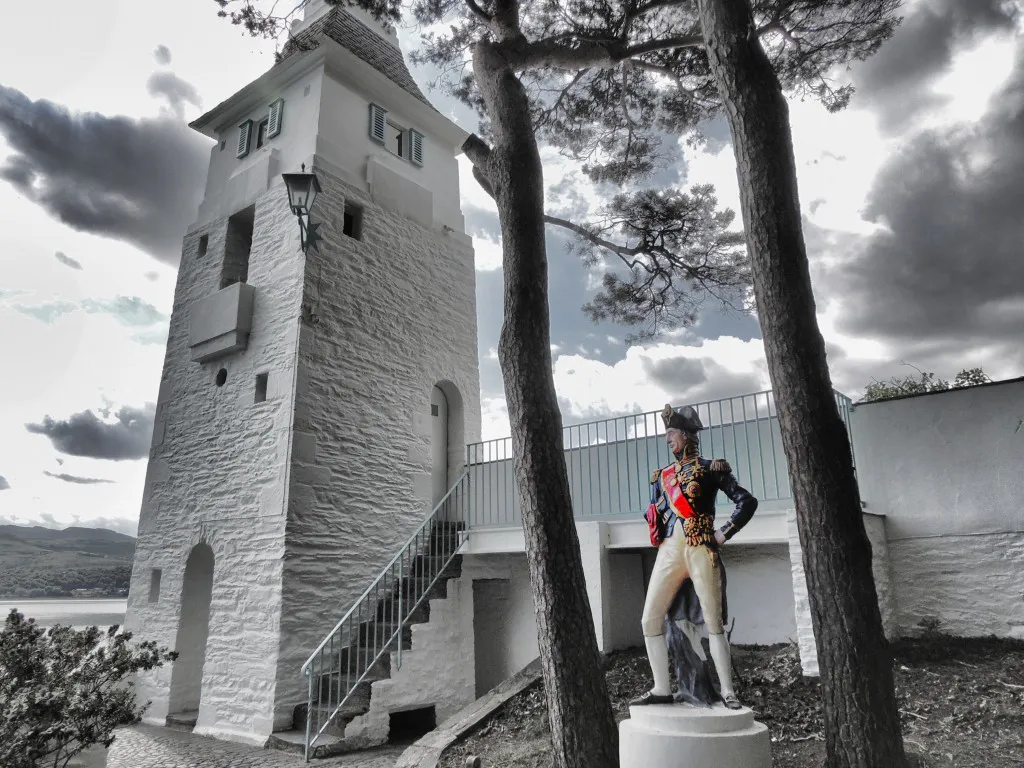
Nelson at Portmeirion
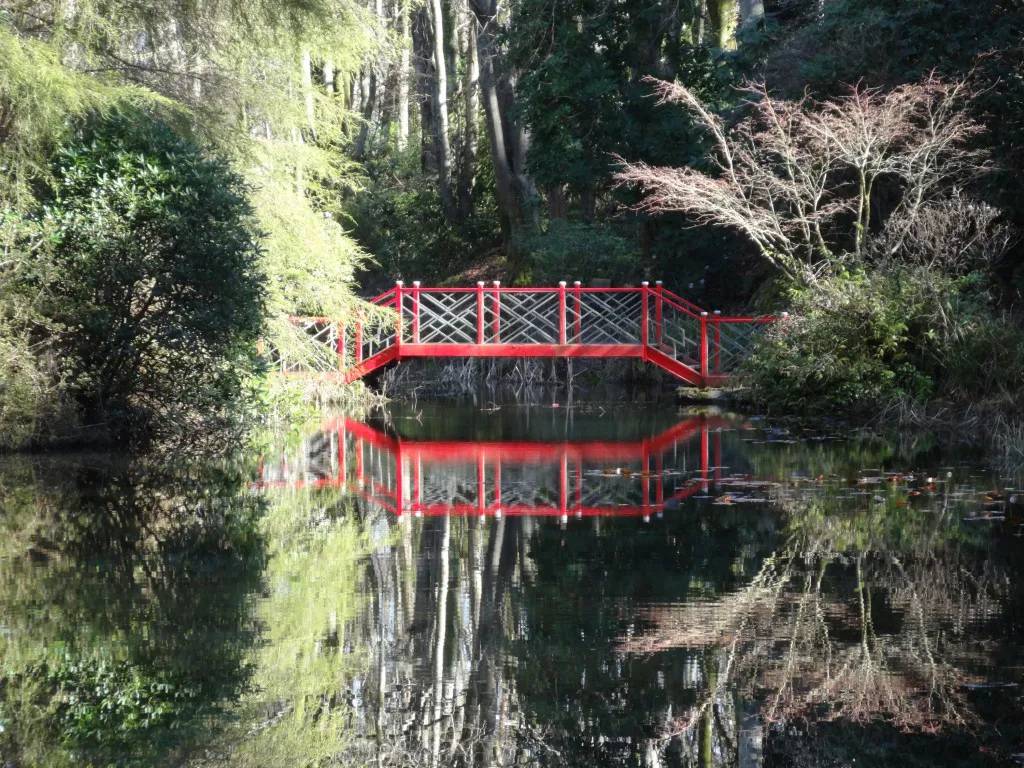
Bridge in the Japanese Garden, Portmeirion