Cader Idris
Dolgellau sits on the northern side of the Cader Idris (Cadair Idris) mountain range with two or three routes to the summit from this side.
The main route follows the Pony Path from the car park at Ty Nant. This is the route for the annual Cader Race.
Cregennen Lakes
Cregennen Lakes consist of two bodies of water, one 27 acres (with a small island) and the other half the size at 13 acres. They are located about 785 feet above sea level, beneath the slopes of the Cader Idris mountain range and are one of the ‘must do’ visits when you come to this area.
If you walk up the little hill, just above the car park, you get a fabulous view towards Barmouth and Cardigan Bay. You also get this view on the ‘way out’ which is usually the road which meanders down to Arthog.
The main ‘pointy’ hill you see beside the lake is called “Pared y Cefn Hir” and is walkable. It is as steep as it looks, but once you are at the top you can follow the undulating path over all the ridges, with views to Barmouth and down on the lakes. You then drop down and follow the path at the base of the hill, or can walk between the lakes past the boat house.
I will include a walk around the lakes in the near future. There are many which you can do; you can walk from Ty Nant car park, or park at Arthog and walk to the lakes via Arthog Falls, killing two birds with one stone. This one also lets you cross the old stone clapper bridge at Llys Bradwen.
Trawsfynydd
Trawsfynydd (Welsh for “Across the Mountain”) is a village with a population of just under one-thousand.
The village is spread around “Llyn Trawsfynydd”, a 1,180 acre man-made reservoir, built between 1924 and 1928 to supply water for Maentwrog hydro-electric power station. Later it’s waters were used to cool the twin reactor Trawsfynydd nuclear power station.
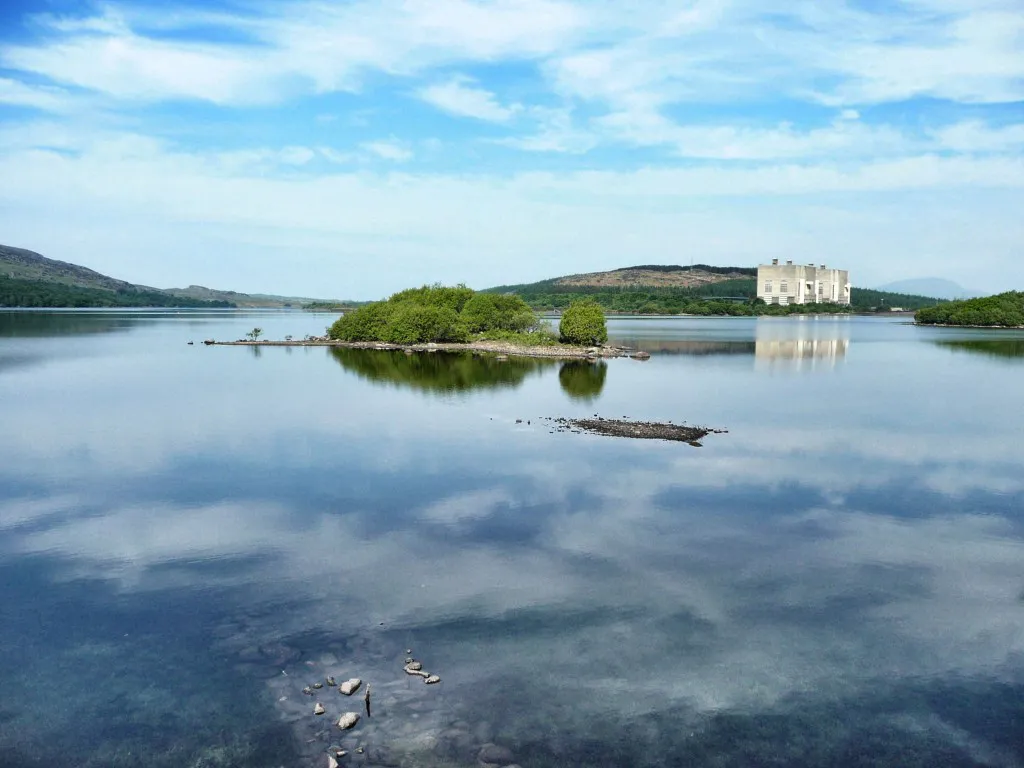
Trawsfynydd Lake
Dolgellau Golf Club
Set amidst spectacular mountain backdrops Dolgellau Golf Club is considered to be one of the most beautiful courses in Wales. Do not be fooled by its lack of length, this 9 hole course with alternating tees for the second nine provides a true test of golf for all standards of golfer. Its small & well protected greens will reward a good straight shot and the free draining land means superb playing conditions can be maintained even in wet weather ensuring year round play.
At Dolgellau Golf Club everybody is welcome to come and use our facilities, a children’s menu is available and dogs are welcome outside. Outside seating is available on our new decking area. The clubhouse and restaurant are open 7 days a week including evenings from April to September and an all day catering service is offered with a wide variety of dishes. Sunday lunches are very popular and it is advisable to book ahead but not essential. Last food orders are 8.30pm during the summer months.
Cymer Abbey & Afon Mawddach Riverside Walk
Park at the car park by Llanelltyd bridge and walk up to the ruins of Cymer Abbey. Just before the Abbey, there is a gate on your left which follows the river tough a couple of gates and a stile. You can follow it to the end and climb over stile and up a steep bank to end up on a quiet road which leads back to Llanelltyd.
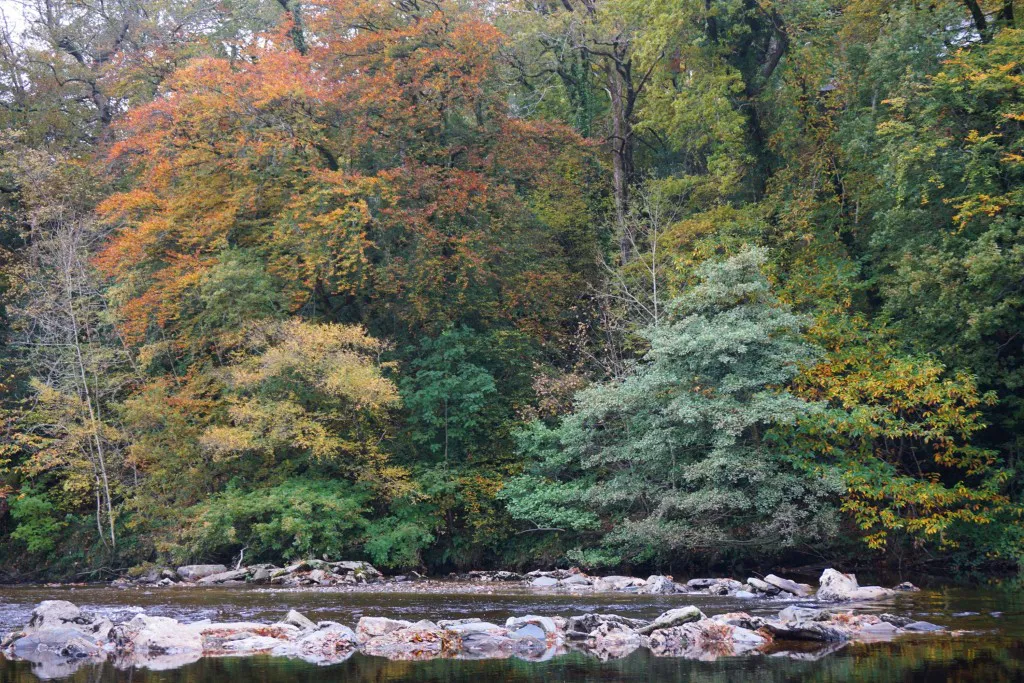
Walk from Cymer Abbey Along The Mawddach in Autumn
Ffynnon
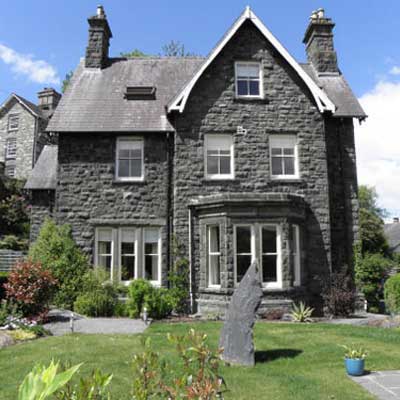
Ffynnon
Situated in the picturesque Snowdonia National Park, Ffynnon Hotel offers 5-star boutique accommodation with magnificent mountain views. The beaches of Cardigan Bay are a 15-minute drive away. Guests can take walks along the forest footpaths that surround the hotel, and climb Cader Idris for spectacular views of the rugged landscape.
Ffynnon combines traditional and contemporary features, including a peaceful library and an outdoor hot tub. The individually designed rooms all have luxury bedding and a flat-screen, satellite TV, and some have freestanding baths. A cooked Welsh breakfast is served in the morning, and a buffet selection is also available. Guests can make use of free wireless internet, and free private parking on site.
Ffynnon is an hour’s drive from Mount Snowdon. The beautiful market and university town of Aberystwyth is also just an hour away by car.
View on the Booking.com Website
Bala Lake Railway
Bala Lake Railway “Rheilffordd Llyn Tegid” offers visitors a beautiful nine-mile return journey beside Bala Lake. The hour-long journey offers stunning views of the lake and Aran mountains (Arenig Fawr, Aran Benllyn and Aran Fawddwy).
The railway currently has four narrow gauge steam locos running; “Alice”, “Holy War”, “Maid Marian” and “Winifred” (all built by the Hunslet Engine Co. of Leeds).
Visit Their Website at bala-lake-railway.co.uk
Map showing all The Great Little Trains of Wales
Dolgellau Chronology 1 (Romans – 1799)
[Roman Times] Signs of Roman “Traffic” at Ffynnon Mair (Mary’s Spring). Roman road passes near Dolgelley, and on the site of the town, coins bearing the inscription “Imp. Caesar Trajan” have been found
[480] Death of Illtyd Farchog (Iltulus), born in Brittany. Gave Llanelltyd its name
[7th Century] Christian missionaries founded a settlement in Dolgellau
[11th Century] Invading Normans under William Rufus, leave the area – ‘returned empty handed having gained nothing’.
[11th or 12th Century] Dolgellau First Inhabited as a “Serf” Village
[1100] Nannau sited at 700ft, it is reputed to be the highest mansion seat in the country. The site was the home of the descendants of Cadwgan, son of Bleddyn, Prince of Powys, since 1100. It was the residence of Howel Sele, a cousin & enemy of Owain Glyndwr
[12th Century] Original St. Mary’s Church Built
[1111] Cadwgan (of Nannau), the founder of Dolgellau Died in Welshpool
[1116] Cymer Castle (Castell Cymer), Llanelltyd a native Welsh castle was built in 1116. The mound or motte was built by Uchdryd ab Edwin. The tree covered motte can still be seen, but contains a stone ‘folly’ on top. The wooden castle is also ‘famous’ for being built and destroyed in the same year (1116).
[1198/9] Cymer Abbey Founded Under the Patronage of Maredudd ap Cynan (Lord of Meirionydd)
[c.1200] Dolgellau first connected to the wool trade.
[1209] Cymer Abbey was Granted a Charter by Llywelyn the Great
[1212] Maredudd ap Cynan (Lord of Meirionydd and Founder of Cymer Abbey) Died
[1240] Llywelyn ab Iorwerth “The Great” Died
[1253] First Document Mentioning St. Mary’s Church “Dolkelew” (in the Norwich Taxatio). This is the Earliest Recorded Spelling of the Town
[1282] Llywelyn ap Gruffudd “The Last” Died
[1284] The Monks of Cymer Abbey Were Awarded £80 Compensation for the Damages Caused by the English Wars
[1285] Another Recorded Spelling of the Town: “Dolgethley”
[1285-1310] Edward 1st makes survey of Merioneth (similar to Domesday Book). Residents of Dolgellau were tenants of the Crown – primarily Welshmen (cattle breeders) and foreigners (Englishmen and Irishmen – agricultural workers).
[1291] St. Mary’s Church Mentioned again in the Taxatio Ecclesiastica
[1291] St. Illtyd Church Built in Llanelltyd
[1295] Edward 1st visited the town and received homage of local tribal chieftains.
[14th Century] St. Mary’s contains a 14th Century effigy of Meurig ap Ynyr Fychan, an ancestor of the Vaughan family of Nannau
[14th Century] Poet Gruffydd ap Adda murdered in the streets of Dolgelley
[c.1340] Walter de Manny established fairs and markets (Vicecombe of the Shire of Merioneth). Tolls were 3.5% of the selling prices of goods
[1349] Owain Glyndwr born
[1388] Cymer Abbey Only Housed Five Monks
[1400] Owain Glyndwr’s Revolt Begins
[1402] Owain Glyndwr Attacked Nannau and Captured Hywel Sele
[1402] Owain Glyndwr Battled Griffith ap Gwyn (Who was Trying to Rescue His Father-in-Law Hywel Sele). Gwyn Lost 60 of His 200 Men on Llanelltyd Bridge
[1402] Hywel Sele Tried to Kill Owain Glyndwr. But Glyndwr Killed Sele and Stuffed His Body Into The Hollow Tree of the Ghost (Ceubren yr Ellyll). When it Lay Hidden for 40 Years
[1404] Owain Glyndwr held the last Welsh Parliament in Dolgellau. It was from here that Owain Glyndwr sent letters to the Kings of Scotland and France, asking for help and pleading the justice of his fight against English usurpation, signing himself ‘Owinus, Dei gratia princeps Walliae datum apud Dolgeuelli 10 mie mensis Maii, MCCCC quatro’
[c.1416] Death of Owain Glyndwr in hiding
[1445] Fresh survey of Merioneth – ‘land now lying derelict for want of men’
[1514] William ap Jenkin ap Iorwerth charged with having terrorised Dolgelley
[1536] Henry VIII Dissolved All Monastaries Earning less than £200 per Annum (Cymer Abbey was Earning £51 and was Dissolved)
[1555] Lewis Owen, vice-chamberlain of North Wales, and baron of the exchequer of North Wales cruelly murdered by The Red Bandits of Dinas Mawddwy. The Red Bandits were known as “Y Gwylliad Cochion” as they had red hair
[1576] Dolgellau was leased out by the Crown and surveyed in the Rolls
[17th Century] Plas Newydd Built at the top (Did Not Have the Bays Originally)
[1606] Y Sosban (The Old Town Hall) Built
[1638] Y Bont Fawr (The Big Bridge) Built. Originally it contained 10 arches but 3 were lost when the railway was built
[1640] St. Mary’s Started to Keep Regular Church Registers
[1650] George III Built in Penmaenpool
[1651] St. Mary’s font has the date 1651. West windows contain 18th Century stained glass
[1657] George Fox Leader of the Quakers Visited the Town and The Quakers were Established in Dolgellau
[1662] A Print of the Old St. Mary’s Church Published (with the church-bell is suspended in a yew-tree)
[1662] Thomas Fuller wrote of Dolgellau in The History of the Worthies of England – ‘There are more alehouses than houses. Tenements are divided into two or more tippling houses and chimneyless barns used to that purpose’
[1665] One of the Earliest Grammar Schools in Wales was Built
[1666] Robert Vaughan of Hengwrt Died
[1675] George Fox visited the area saying he had found an earthly Paradise and that ‘here is a valley of peace and beauty’.
[1678] Register of Dolgellau Parish Church (1678 – 1708). Entries of burials confirmed that woollen shrouds were being used. A law was passed in 1678 to encourage the wool trade, making it obligatory to use these shrouds
[1686] Rowland Elis, a prominent local Quaker, emigrated to Pennsylvania
[1694] Robert Norden’s map of North Wales links the mail route from the West Midlands with Caernarfon via Dolgellau for the first time, among a few other Welsh towns. In those days, the Inns doubled up as post offices, to serve the travellers
[1700] Wtra Plas Coch Built
[18th Century] The town had 6 Skinners Yards, 3 Tanneries. About 100,000 local lambskins, as well as many kid skins were sent to Worcester and Chester every year and some to London. There were two kinds of tanneries ; heavy leather that tanned hides, and light leather dealing with sheepskins
[1715] Death of Dr. Daniel Williams. A trust was established from his will to eventally set up Dr. Williams School
[1716] Old St. Mary’s Church Demolished
[1716] Town Jail Built (The Clifton House Hotel now stands on the site).
[1721] Reverend Ellis Lewis left a sum of money for a peal of eight bells at the Parish Church. 1st, 2nd and 3rd chimed for Divine Service, 4th for curfew, 5th for a fire, 6th for a funeral, 7th (Y gloch goll) for someone missing on Cader Idris, and the 8th was for Communion
[1725] Baron Richards born at Coed, Brithdir in Dolgelley Parish. Well educated, he became Chief Justice of Chester, Baron of the Exchequer and Lord Chief Baron
[1750] John Wesley visited Dolgelley, making non-conformity a force
[c.1755] The road to Bala was built, replacing the old track
[1765] Richard Wilson painted “Cader Idris – Llyn-y-cau”. Now hanging in the Tate Gallery in London. One of the masterpieces of 18th century art
[c.1770] Bakery established in The Lawnt – Popty’r Lawnt
[1780] Fulling Mills Extablished
[1791] Universal British Directory. Dolgelly – Situated at the bottom of that romantic high hill called Kader Iris. Here is a modern-built parish church. The buildings in general, are low and irregular. The markets are on Tuesdays and Saturdays, and there are 7 fairs in the year. The tide flows within a mile of the town. The principal occupations of the town are, Physicians 2, Lawyers 3, Merchants 7, Grocers 4, Web-manufacturers 11, Web-merchants 1 Tanners 3, Skinners 5, Mercer 1 Currier 1, Carrier 1, Corn factorer 1, Timber merchant 1, Woolstapler 1, Plumber/glazier 2 and Sadler 2
[1794] Thirty six people die of smallpox in Dolgelley
[1796-98] Intollerable Poor Law pressed on Dolgelley.The 1796 poor rate was 8 shillings (40p) in the pound
[1798] The Earliest Printing Press Opens
[1798] Fifteen shillings (75p) paid to a Mary Jones for washing Parish linen
[1798] The Baptists were established in the town
[1799] Hen Dafarn Drws-y-nant (The Old Tavern at the Gateway of the Stream) was rebuilt by Sir Robert Hywel Vaughan. It stands up the steep pass of Garneddwen, between Dolgellau and Bala, a wild and unhinabited region. Was once described by a traveller as ‘a poor hovel’
Foel Offrwm
This walk starts at the Precipice Walk car park and can be done at the same time as it’s only 30-40 minutes to the top (0.8 miles). While the Precipice Walk car park can be full in peak times, only a few of those people will be walking this route. I have done it a few times and never seen another soul on the way up, or on the way down. There are no markers at any point along the route, which may account for this.
Starting at the car park at 750 feet, the first half is a gentle climb (only ascending around 100 feet), while the second half is a steeper affair over rough stony and uneven ground and 400 feet of ascent.
Starting from the car park, cross the road you just drove up (if you drove up from Dolgellau) and take the signed path opposite. Before you get to the gate, turn right up a sloping path and over the fence (this path is NOT signposted) and follow the feint grassy path around the base of the hill until you reach a wall. It’s all pretty easy from here, just turn right and follow the wall up (and I mean UP!). This path is uneven and steep, but keep stopping and look back for some nice views of Coed y Brenin, Northern Snowdonia and the village of Llanfachreth and its church dedicated to Celtic saint Machreth.
Once at the top you are rewarded by a walk around the ruins of an Iron Age Hill Fort and a stone tower (of later construction). You also get some stunning panoramic views, including Dolgellau, Barmouth and a nice view of Nannau house and gardens below.
The route down is a little trickier with the uneven ground, but you are helped by the fact that there is a stone wall to hang on to.
Coed-y-Brenin
World famous Mountain Biking centre near Dolgellau. Forestry Commission Wales’ mountain bike Mecca Coed-y-Brenin forest is home to an ever increasing network of fantastic all weather tracks, which include ‘Falseteeth’ incorporating the biggest feature in the forest, ‘The Cavity’.