



Gwrych Castle History: The Hillside Castle Near Abergele
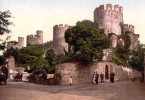
Gwrych Castle is a Grade I listed Gothic Revival mansion on a wooded hillside above Abergele on the north Wales coast. It was begun around 1810 by Lloyd Hesketh Bamford-Hesketh, and was extended by later owners over the following century. It is not a medieval fortress: the battlements, towers and walls were all designed to look old, as part of the Romantic taste for medieval architecture.
Its later story is just as unusual as its appearance, taking in a wartime refuge for children, decades of neglect and a rescue led by a local campaigner.
Who built Gwrych and when
Published accounts agree that Lloyd Hesketh Bamford-Hesketh (1787 to 1861) began rebuilding the estate in 1810 and that work continued until about 1825. The foundation stone is recorded as 1819. Several architects had a hand in the design. Charles Busby exhibited designs at the Royal Academy in 1815, but he was later dismissed and Thomas Rickman was engaged in his place, which moved the plan from a Regency country house towards a full Gothic castle.
Later owners kept adding to it. Published accounts list further work by Henry Kennedy, George Edmund Street and, in 1914, Detmar Blow. The result is a long, layered silhouette running along the hillside.
From family seat to royal gift that wasn’t
Winifred Bamford-Hesketh inherited the estate in 1894. When she died in 1924 she left the castle to King George V in the hope that it would become a Welsh residence for the Prince of Wales. The gift was declined. Her former husband bought the property back in 1928 for a reported £78,000.
Refugee children in the Second World War
Between 1939 and 1941 the castle housed Jewish children who had left Central Europe, many of them through the Kindertransport rescue effort. The group was run by the Bnei Akiva movement. Published accounts, including Wikipedia and a Jewish News report, put the number at about 200 children, who came under the Kindertransport programme.
Visitor attraction, then decline
After the war Robert Rennie bought the castle in 1946 and opened it to the public as an attraction. It closed in 1987. In 1989 it was sold to an American businessman for a reported £750,000, and over the following years it was looted and vandalised. A later purchaser in 2007 paid a reported £850,000, but plans for a hotel came to nothing. By this stage roofs had gone, interiors were open to the weather, and the castle appeared on lists of heritage buildings at risk.
Rescue and the Gwrych Castle Preservation Trust
The turning point came when the Gwrych Castle Preservation Trust, whose creation is credited to the campaigner Mark Baker, bought the castle and about 200 acres in 2018 with the help of the National Heritage Memorial Fund. The trust has since carried out repairs and stabilisation work, which is slow because of the scale and the condition of the masonry.
Listing, grounds and the “at risk” label
The castle is Grade I listed, and the surrounding estate is graded II* on the Cadw register of parks and gardens of special historic interest in Wales. Those grades matter because they tell you the buildings and designed landscape are of national importance, not just local charm. Even so, Wikipedia records that Cadw placed the castle in its highest risk category on the Buildings at Risk register in 2024, a reminder that listing protects a building on paper but does not pay for repairs.
Part of the estate land is leased to Natural Resources Wales for 999 years, which means the wooded slopes and the castle are managed by different bodies.
How the design reads on the ground
Looking up from the lower road, the castle reads as a long line of towers, turrets and curtain walls climbing the hillside. That is deliberate. In the early nineteenth century, owners of country estates liked the look of medieval defence without needing the real thing, and Gwrych was built as a statement of status and taste. The mock fortifications were never tested in battle. The interesting question for a visitor is therefore less “who attacked it?” than “who paid for it, and who kept it going?”, which is why the ownership history above is so central.
Gwrych on television
Many people first met the castle through TV. Series 20 of I’m a Celebrity… Get Me Out of Here! was filmed there in late 2020, and the show returned for series 21 in November 2021. The exposure brought fresh attention to the repair effort, although fame does not remove the maintenance bill.
Visiting and what to expect
Opening arrangements, tours, tickets and parking are set by the trust and change from season to season, so check its official channels before travelling. Expect uneven ground and a steep walk in places. Check public transport options with the operators before you travel.
Gwrych sits at the northern edge of the area this guide covers. For something closer to the mountains, the story of the slate railway in Blaenau Ffestiniog and the harbour-town character of Porthmadog make good companions.
Frequently asked questions
Is Gwrych Castle a real medieval castle?
No. It is a nineteenth-century Gothic Revival house, built from about 1810, designed to look medieval. It is nevertheless Grade I listed, a category reserved for buildings of exceptional interest.
Where is Gwrych Castle?
It stands on a hillside near Abergele in Conwy County Borough, north Wales, close to the coast. It lies outside the mountain core of Snowdonia but within easy reach by road or rail.
Who owns Gwrych Castle now?
The Gwrych Castle Preservation Trust bought the castle and roughly 200 acres in 2018. Ownership can change, so confirm with the trust or Cadw if you need current details.
Was Gwrych used in a TV show?
Yes. I’m a Celebrity… Get Me Out of Here! used it as its UK base for series 20 (2020) and series 21 (2021).